Dr. Fin Clementwood
Dr. Fin Clementwood
modelling
crystallisation
Polylactic Acid for 3D printing
Dr. Fin Clementwood
modelling
crystallisation
Polylactic Acid for 3D printing
Dr. Fin Clementwood
modelling
crystallisation
Polylactic Acid for 3D printing
ASTHETIC SCIENCE
Polarised Light Microscope X Washing-up Liquid
Location /
Maastricht University
Role /
Team Project
Purpose/
Project period
Year /
2014
Location /
Maastricht University
Role /
Team Project
Purpose/
Project period
Year /
2014
Location /
Maastricht University
Role /
Team Project
Purpose/
Project period
Year /
2014
Location /
Maastricht University
Role /
Project design and lead
Purpose/
Project period
Year /
2014
Dr. Fin Clementwood
modelling
crystallisation
Polylactic Acid for 3D printing
Location /
Maastricht University
Role /
Team Project
Purpose/
Project period
Year /
2014
Dr. Fin Clementwood
modelling
crystallisation
Polylactic Acid for 3D printing
Location /
Maastricht University
Role /
Team Project
Purpose/
Project period
Year /
2014
Dr. Fin Clementwood
modelling
crystallisation
Polylactic Acid for 3D printing
Location /
Maastricht University
Role /
Team Project
Purpose/
Project period
Year /
2014
Dr. Fin Clementwood
modelling
crystallisation
Location /
Maastricht University
Role /
Team Project
Purpose/
Project period
Year /
2014
Dr. Fin Clementwood
modelling
crystallisation
Location /
Maastricht University
Role /
Team Project
Purpose/
Project period
Year /
2014
Dr. Fin Clementwood
modelling
crystallisation
Location /
Maastricht University
Role /
Team Project
Purpose/
Project period
Year /
2014
Dr. Fin Clementwood
modelling
crystallisation
Location /
Maastricht University
Role /
Team Project
Purpose/
Project period
Year /
2014
Dr. Fin Clementwood
modelling
crystallisation
Location /
Maastricht University
Role /
Team Project
Purpose/
Project period
Year /
2014
Dr. Fin Clementwood
modelling
crystallisation
Location /
Maastricht University
Role /
Team Project
Purpose/
Project period
Year /
2014
BACKGROUND
Polarised light microscopy THEORY + microscopy
Process of utilising it & Rachel discovered it
Stunning images with vivid colours that shifted when the bubbles popped and moved. The result is a vivid array of textural and unfamiliar streaks of light, shadow and refracted patterns. The shapes of other bubbles are reflected, amplified and diminished like small lenses.
[Add watermark to images]
Polylactic Acid for 3D printing
Polylactic Acid for 3D printing
Polylactic Acid for 3D printing
Polylactic Acid for 3D printing
Polylactic Acid for 3D printing
Polylactic Acid for 3D printing
Dr Fin J Hazelwood

Introduction
There are many parts in an aeroplane, and they are designed to never fail.
However, if one part would fail, how would it affect the system?
Each component relies upon another, and their relationships matter. If one part were to break, it could cause a chain reaction as the next part also fails and so the whole system is compromised.
Aim: Create a framework for understanding how part failure occurs and the impact on the rest of the system. We want to know how to design these systems to make them resilient.
Location /
Maastricht University X Cambridge University
Role /
Researcher
Purpose/
Bachelor thesis
Year /
2015
Supervisors/
Nigel Ball
Method
For each component it was considered:
- How likely are parts to fail?
- How severe would a failure be?
Using this information we could estimate a level of risk to study the designs. The objective was to find the most optimal design - this would be the design that involved the least risk and was therefore the most resilient. However, there are many different combinations of options - too many to explore ourselves.
We have a landscape of options to investigate, some with low or high likelihood of failure and others with low or high severity of failure. Options with a low risk are good and we want to find them. So instead of doing the calculations for each point, we use a tool to search this landscape for us.
The tool is called a genetic algorithm, and it works by exploring some points in this landscape and reporting back the findings. The instructions for where to look are changed each iteration using mutations. When the algorithms start to find an area that is promising, mutations that give promising results are favoured in the next generation, and the mutations that give areas that are non promising do not get carried forward in the next iteration. The result is a system that provides optimal solutions and helps us appraise the quality of designs.
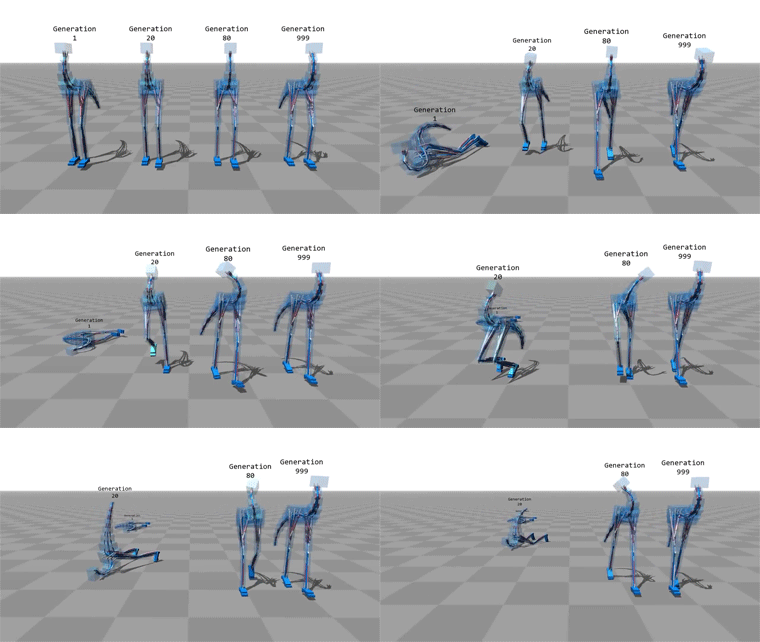
An excellent example of a genetic algorithm used to model the walking of a bipedal design. Source: Reddit
Outcome
This process provided a set of data which was useful in informing us which designs appeared to be desirable. In order to make better use of the many scenarios found in the data it was visualised to show the progression of the algorithms to validate and communicate the findings.
Conclusion
The PDF document below shows the final paper if you would like to look through the research in more depth. The project concluded with an examination of risk profiles that help to assess a set of designs for resilience. The validation of the model was useful for future stages of research and have since been used in collaboration with industry partners.
